
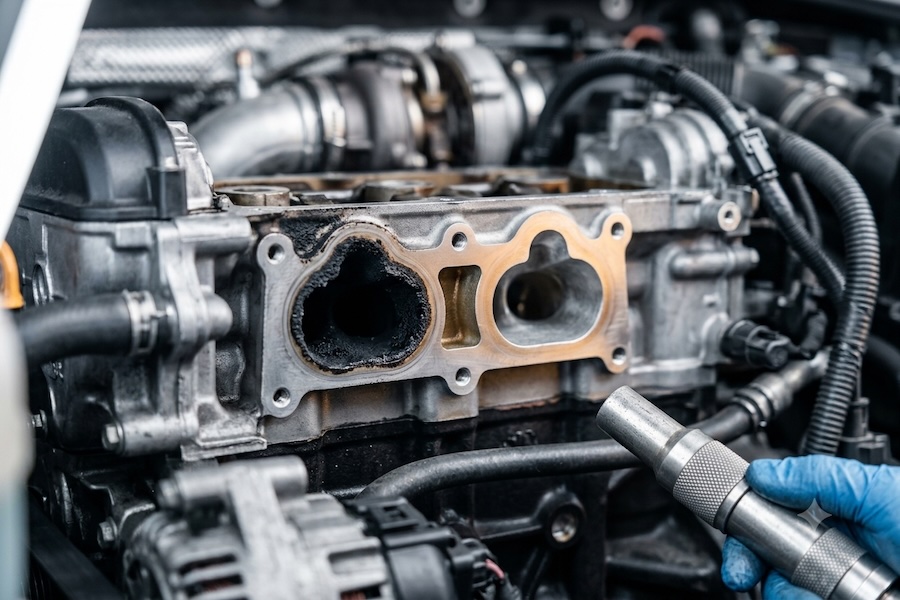
Your Audi or VW felt sharp when you bought it. Now the idle is rough, cold starts stumble and the throttle response has gone soft. Nothing shows up on a scan, and the dealer tells you it’s normal for the mileage. It isn’t. What’s happening is carbon buildup on the intake valves, and it affects nearly every direct-injected engine Audi and Volkswagen have built since roughly 2008.
Why Direct Injection Creates the Problem
Older port-injected engines sprayed fuel just ahead of the intake valve, and that constant gasoline wash scrubbed the valve clean every cycle. Direct injection moved the injector into the combustion chamber for better efficiency and power, which means fuel never touches the back of the intake valve anymore. Meanwhile the positive crankcase ventilation system routes oil vapor into the intake tract, and the exhaust gas recirculation system adds soot to the mix. Those deposits bake onto the valve at operating temperature and harden into a crusty layer that chokes airflow. On a 2.0T TSI or a 3.0T supercharged V6, we routinely find deposits thick enough to visibly narrow the intake port by 40,000 miles.
What San Jose Driving Does to Make It Worse
Stop-and-go traffic on 101 and 280 is the worst possible condition for carbon accumulation. Short trips and low-load commuting never let the engine reach the sustained temperatures that help burn off some deposits. If your daily drive is Willow Glen to a Santa Clara office park, you’re accumulating carbon faster than someone doing highway miles to Sacramento. Symptoms usually start subtle. Cold-start misfires that clear after thirty seconds, a slight hesitation under light throttle or fuel economy dropping two or three miles per gallon. Left long enough, you’ll get stored misfire codes and noticeable power loss.
Why Walnut Blasting Is the Real Fix
Chemical intake cleaners and fuel additives can’t reach the intake valve because the fuel path bypasses it entirely. The only reliable method is media blasting with crushed walnut shells, which strips deposits without damaging the valve or seat. The intake manifold comes off, each port gets blasted individually and everything is vacuumed clean before reassembly. Most engines benefit every 45,000 to 60,000 miles. It’s a half-day job that restores factory throttle response.


Recent Comments